


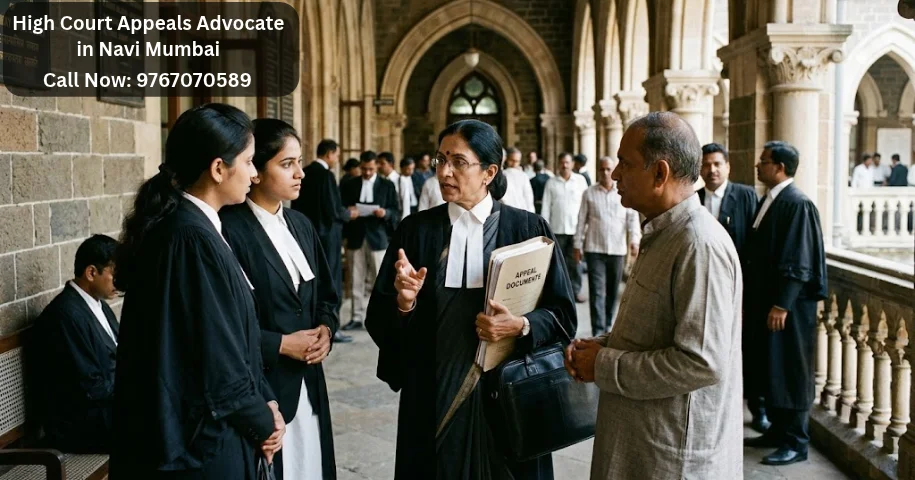
High Court Appeals Advocate in Navi Mumbai





High Court Appeals Advocate in Navi Mumbai | Law Mantri
Finding the right High Court Appeals Advocate in Navi Mumbai is an important step when considering an appeal, challenging a judgment, addressing a criminal case, or resolving a family, property, or corporate dispute. Understanding your legal rights, applicable laws such as the Bharatiya Nyaya Sanhita (BNS), court procedures, and available remedies can help you make informed decisions and prepare for the next stage of legal proceedings.
Lawmantri is a legal services platform with over 6 years of experience, helping individuals, families, and businesses explore suitable legal assistance for criminal trials, personal and family matters, divorce, property disputes, corporate cases, arbitration, and related legal concerns. The platform provides access to lawyers with approximately 5 to 10 years of professional experience, helping clients understand their legal options and seek guidance relevant to their specific circumstances.
About Us
Lawmantri is a legal services platform with over 6 years of experience, helping individuals and businesses explore legal assistance for a wide range of legal concerns. It covers criminal trials, High Court appeals, personal and family matters, divorce, property disputes, corporate cases, and arbitration.
With access to lawyers who have approximately 5 to 10 years of professional experience, Lawmantri aims to help clients understand legal procedures, evaluate available remedies, and make informed decisions based on their individual circumstances.
What Does a High Court Appeals Advocate Do?
A High Court appeals advocate represents or assists clients in challenging eligible judgments, decrees, sentences, or orders before a High Court. Appeals require a careful examination of the original proceedings, the applicable law, the evidence on record, and the legal grounds available for challenging the decision.
Unlike a trial, where witnesses may be examined and evidence presented according to the applicable procedure, an appeal generally focuses on whether the lower court’s decision contains a legal, procedural, evidentiary, or other reviewable error. The precise scope depends on the type of proceeding and the relevant statute.
A High Court appeals advocate may assist with:
- Reviewing the judgment or order being challenged.
- Identifying legally sustainable grounds of appeal.
- Examining the trial record, evidence, pleadings, and procedural history.
- Preparing an appeal memorandum and supporting applications.
- Advising on limitation periods and filing requirements.
- Seeking a stay of an order or sentence where legally available.
- Preparing written submissions and arguments.
- Representing clients during appellate hearings.
- Advising on possible further remedies after the High Court’s decision.
Not every unfavourable decision can automatically be appealed. Some orders are appealable as of right, some require statutory conditions to be satisfied, and certain matters may be addressed through revision, review, or another appropriate legal remedy. A lawyer should examine the particular order before recommending a course of action.
Why Consult a High Court Appeals Advocate in Navi Mumbai?
People often seek appellate legal assistance after discovering that a judgment has serious consequences for their personal life, business operations, property ownership, or criminal liability. An appeal may offer a legal route to challenge an eligible decision, but its viability depends on the facts, the record, the applicable legislation, and the procedural requirements.
A lawyer familiar with appellate practice can help you understand the strengths and limitations of your case before you commit to the next stage of litigation.
1. Understanding the Judgment
The first step is to understand precisely what the court decided and why. An appeal should address the reasoning and findings in the judgment rather than simply repeat the arguments made during the original proceedings.
A legal review may identify an incorrect interpretation of a statutory provision, a disputed finding that can legally be challenged, a material procedural irregularity, or an issue concerning the admissibility or appreciation of evidence.
2. Identifying the Correct Legal Remedy
The appropriate remedy depends on the type of case and the order passed. For example, a criminal conviction may involve a statutory criminal appeal, while a civil dispute may involve a first appeal, second appeal, or another remedy under the relevant law.
A challenge to an interim order may follow different requirements from an appeal against a final judgment. Certain orders may not be independently appealable.
An advocate can examine these distinctions and help determine which route, if any, is legally available.
3. Meeting Filing Deadlines
Appeals are subject to limitation periods and procedural rules. Missing a deadline can create significant difficulties, although the relevant law may permit an application for condonation of delay in appropriate circumstances.
The applicable time limit must be checked for the specific case. It is unsafe to assume that every High Court appeal has the same deadline.
4. Preparing Focused Legal Arguments
A well-prepared appeal generally identifies the challenged findings, explains the alleged errors, connects those errors to the applicable legal provisions, and specifies the relief sought.
Clear arguments help the court understand the legal questions involved. The appropriate strategy should be based on the actual record rather than unsupported allegations or unrealistic expectations.
5. Understanding Interim Relief
In some matters, a party may seek interim protection while an appeal is pending. Depending on the proceeding, this could involve a request for a stay of an order, suspension of a sentence, bail, or another form of temporary relief.
Such relief is not automatic. The court considers the governing law and circumstances of the case.
Understanding the Bharatiya Nyaya Sanhita (BNS)
The Bharatiya Nyaya Sanhita, 2023, commonly called the BNS, is India’s principal criminal law statute defining offences and prescribing punishments within its scope. It came into force on 1 July 2024.
The BNS replaced the Indian Penal Code, 1860, subject to the applicable commencement and transitional provisions. It forms part of a wider change in India’s criminal law framework alongside the Bharatiya Nagarik Suraksha Sanhita, 2023 (BNSS), which addresses criminal procedure, and the Bharatiya Sakshya Adhiniyam, 2023 (BSA), which addresses evidence.
- BNS: Defines criminal offences and their punishments.
- BNSS: Governs criminal procedure, including investigation, trial, and relevant appeal mechanisms.
- BSA: Governs rules relating to evidence.
The applicable law in an individual case can depend on when the alleged offence occurred, the stage of the proceedings, the relevant transitional provisions, and other case-specific considerations.
Contact Us
When Should You Consider Filing a High Court Appeal?
Whether you can approach the High Court depends on the nature of the case and the legislation governing the original proceedings. An adverse decision does not automatically create an unrestricted right of appeal.
Common situations in which a High Court appeal or another higher-court remedy may need consideration include the following.
Challenging a criminal conviction
An acquittal may be challenged only through the procedure and conditions prescribed by law. Depending on the circumstances, an appeal may require special leave or compliance with other statutory requirements.
The fact that a complainant or another party disagrees with an acquittal does not, by itself, establish that an appeal will be entertained.
Challenging a civil judgment or decree
Civil disputes can concern property ownership, contractual obligations, financial claims, inheritance, commercial transactions, and other legal rights. Depending on the nature of the decree and the procedural framework, an appeal may lie before a district court or the High Court.
It is therefore important to identify the correct appellate forum instead of assuming that every civil judgment can be appealed directly to the High Court.
Seeking relief against an unlawful order
Some cases may require consideration of revision, a writ petition, or another form of judicial review rather than an ordinary appeal. These remedies have distinct legal requirements and are not interchangeable.
An advocate should examine the source of the challenged order, the authority that passed it, available alternative remedies, and the relief being requested before recommending a procedural route.
Applying for interim relief
In an appropriate case, a party may seek a stay of the operation of an order, suspension of a sentence, bail, or another interim measure. Such relief is not automatic merely because an appeal has been filed.
The applicant must satisfy the applicable legal requirements, and the court will assess the circumstances of the case.
Common Legal Grounds Considered in Criminal Appeals
Every appeal must be assessed on its own facts. Nevertheless, criminal appellate proceedings may involve recurring legal questions.
Incorrect interpretation of a statutory provision
An appeal may raise an issue where the trial court interpreted a provision incorrectly or applied a legal test that does not match the statute.
For a BNS-related case, the advocate may need to examine the wording of the offence, the required ingredients, applicable exceptions, and relevant judicial interpretations.
Improper appreciation of evidence
The judgment may need examination to determine whether material evidence was overlooked, whether contradictory testimony was addressed, or whether the conclusions drawn from the record are legally sustainable.
An appellate court’s powers are governed by the applicable law and the nature of the appeal. The existence of a different possible interpretation does not automatically establish a ground for interference.
Failure to consider a defence
Where the accused raised a legally relevant defence, the advocate may examine whether the trial court considered it properly and whether the evidence and applicable law support the proposed appellate argument.
The strength of such a ground depends on the record and the legal requirements of the particular offence.
Procedural irregularities
A criminal appeal may raise issues concerning jurisdiction, compliance with mandatory procedure, admissibility of evidence, or another procedural error.
Not every irregularity will invalidate a trial. The legal effect depends on the relevant statute, the nature of the defect, and whether the applicable legal test for interference is satisfied.
Legality of the sentence
A sentence may be challenged where a recognised legal ground exists, including an argument that the punishment is inconsistent with the applicable statutory framework.
The advocate must distinguish between a legally sustainable challenge and a general request for leniency. The relevant provisions, circumstances, and appellate powers determine what relief may be available.
High Court Appeals Advocate for Property Disputes
Property disputes can involve ownership, title, possession, inheritance, partition, development agreements, contractual obligations, or disputes relating to land and buildings.
In Navi Mumbai and surrounding areas, a property dispute may involve multiple documents, transactions, parties, and procedural stages. The appropriate remedy depends on the type of property, the legal rights asserted, the original court’s decision, and the applicable law.
When might a property judgment be challenged?
An appeal may be considered where a civil court has passed a decree that can legally be appealed and the party identifies sustainable grounds for challenging it.
Possible issues may concern the interpretation of a contract, the evaluation of title documents, the application of a legal principle, or the treatment of evidence. Whether these issues justify appellate intervention depends on the record and the applicable standard of review.
What documents can help?
Depending on the case, relevant materials may include sale deeds, agreements, property records, title documents, mutation records, court orders, pleadings, and correspondence.
A property lawyer or appellate advocate should distinguish between evidence of possession, revenue entries, contractual rights, and legal title. These concepts are not always interchangeable.
Lawmantri’s property-dispute service category may be relevant to individuals seeking to understand their legal options in property-related litigation.
How to Choose a High Court Appeals Advocate in Navi Mumbai
Choosing legal assistance should involve more than selecting a professional based on proximity or a short online description. The relevant experience and procedural knowledge should match the case.
Assess relevant legal experience
A lawyer who regularly handles the relevant category of case may be better positioned to identify the issues that require attention. Ask about experience with similar matters, appellate procedure, the relevant legislation, and the court involved.
Lawmantri highlights a platform history of more than six years and access to lawyers with approximately five to ten years of professional experience. Individual credentials, enrolment status, practice history, and suitability should be verified for the particular engagement.
Understand the proposed legal strategy
The advocate should be able to explain the potential grounds of appeal, the documents required, procedural hurdles, and the limitations of the proposed case.
The explanation should be clear enough for you to understand why a remedy is being considered and what issues remain uncertain.
Experience
Lawmantri has over 6 years of platform experience, connecting clients with lawyers who have approximately 5 to 10 years of professional experience.
Expertise
Lawyers can provide legal assistance in High Court appeals, criminal trials, BNS-related matters, family disputes, property cases, corporate litigation, and arbitration.
Authoritativeness
Lawmantri covers multiple legal practice areas to help individuals and businesses understand their legal options and navigate complex legal proceedings.
Trustworthiness
Lawmantri encourages informed legal decisions through clear communication, professional guidance, and case-specific assessments without guaranteeing outcomes.
Frequently Asked Question(FAQs)
Q1. What does a High Court Appeals Advocate in Navi Mumbai do?
Ans: A High Court appeals advocate reviews judgments, identifies potential legal grounds, prepares appeal documents, and represents clients where legally permitted.
Q2. Can I appeal a criminal conviction under the BNS?
Ans: Yes, an appeal may be available depending on the applicable law, the original court, and the nature of the conviction.
Q3. Can a High Court appeal automatically stop a sentence?
Ans: No, suspension of sentence or other interim relief generally requires a separate application where permitted by law.
Q4. What documents are needed for a High Court appeal?
Ans: Common documents include the judgment, relevant court orders, pleadings, evidence, and other papers required by the applicable court rules.
Q5. Which legal services does Lawmantri cover?
Ans: Lawmantri covers criminal trials, family matters, divorce, property disputes, corporate cases, arbitration, and related legal assistance.
Contact Us
Discuss your matter with a criminal defence lawyer and confirm availability before you proceed.
- 📞 Contact: 9767070589
- ✉️ Email: support@lawmantri.in
- 🌐 Website: https://lawmantri.in/
- 📍 Address: C/03, Philips Chsl, Philips Complex, Bhabola Naka, Papdy Road, Vasai West, Mumbai, Maharashtra 401207
Conclusion
Lawmantri offers access to legal assistance across multiple practice areas, supported by over 6 years of platform experience and lawyers with approximately 5 to 10 years of professional experience. Seek case-specific legal guidance to understand your options, procedural requirements, and the next steps in your matter.
Lawmantri offers access to legal assistance across multiple practice areas, supported by over 6 years of platform experience and lawyers with approximately 5 to 10 years of professional experience. Seek case-specific legal guidance to understand your options, procedural requirements, and the next steps in your matter.
“Don’t forget to share this post!”